Project help / stitch reminder
Work one US double crochet, then return to your round.
A five-step reminder for the US double crochet (UK treble crochet), with the loop count stated at the only moments where beginners usually lose track.
In the coaster: Used in the coaster groups. Make Mode tells you whether the target is a ring, chain space, or another project-specific location.
Return to the current round in Make Mode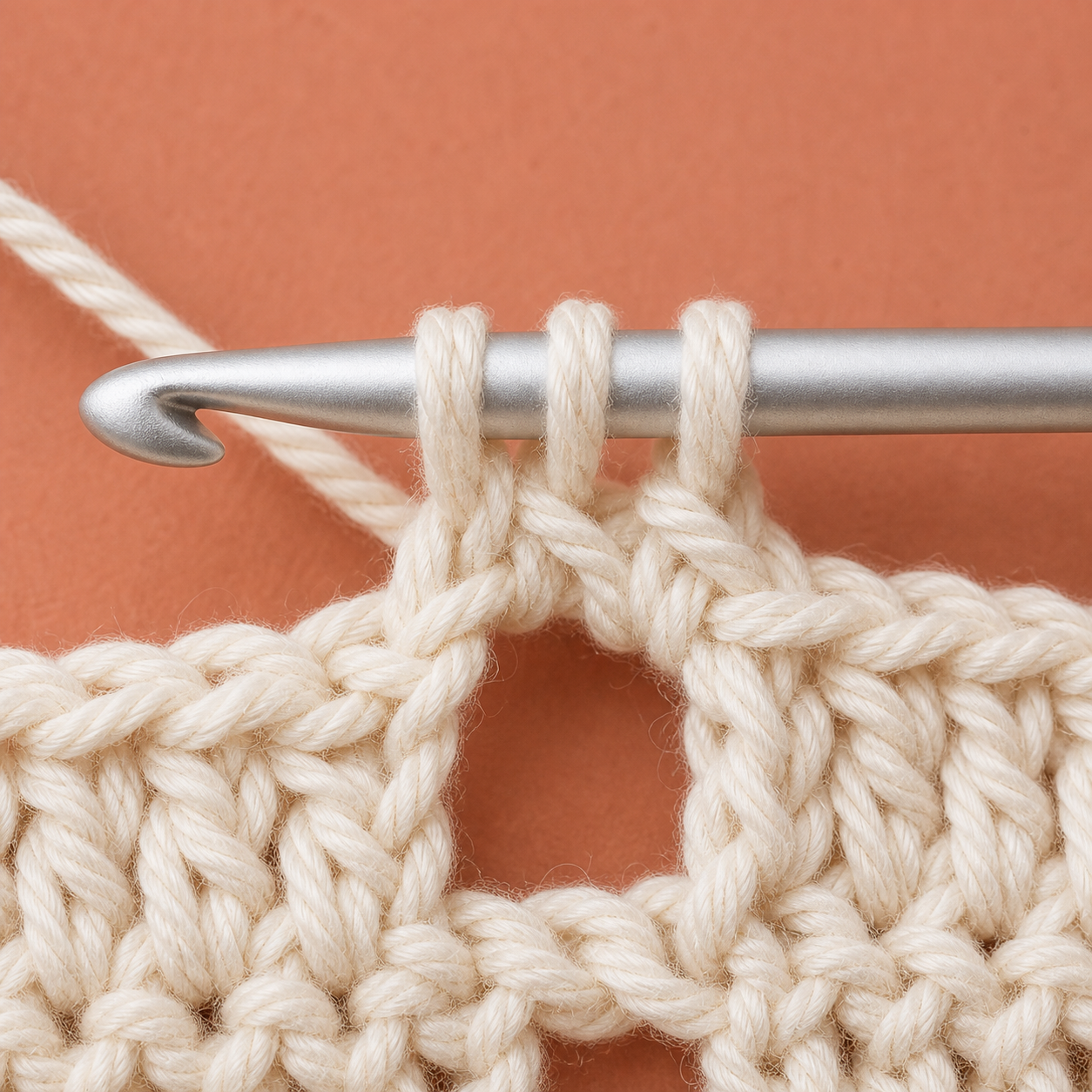
One state to confirm
Check this before the first pull-through: 3 loops.
After yarn over, insert, yarn over and pull up a loop, you should see three loops on the hook. If you do not, pause before pulling through two; Make Mode still decides which named space you entered.
-
Step 1
Yarn over.
Hook: 1 loop.
-
Step 2
Insert hook into the target.
Use the ring or space named by Make Mode.
-
Step 3
Yarn over and pull up a loop.
Hook: 3 loops.
-
Step 4
Yarn over, pull through 2.
Hook: 2 loops.
-
Step 5
Yarn over, pull through 2.
Hook: 1 loop.
AI-assisted instructional visual. These images support the named state; use the written step and your own visible loops as the deciding check, not image realism.
Technical action diagrams
- Action 1
Yarn over
Bring the working yarn over the hook once before moving to the target shown by Make Mode.
Look for: Hook: 1 loop. The yarn over sits around the hook before you insert.
- Action 2
Insert hook into the target
Put the hook through the open ring or chain space named by the project.
Look for: The project decides where; this page only explains the hand motion.
- Action 3
Pull up a loop
Yarn over and draw up a loop through that target.
Look for: Hook: 3 loops.
- Action 4
Pull through 2
Yarn over and pull through the first two loops on the hook.
Look for: Hook: 2 loops.
- Action 5
Pull through final 2
Yarn over and pull through the remaining two loops.
Look for: Hook: 1 loop. One completed double crochet stands below the hook.
Check before returning
Look at the yarn, not only the diagram.
A completed US double crochet has one visible crossbar and a clean top loop; it should not be pulled tighter than its neighbours.
Common mistake: Working the stitch into the wrong place. The hand movement can be correct while the project placement is wrong.